Category: Flash Fiction

  • “Naked Babies” by Julia Strayer

    “Naked Babies” by Julia Strayer

    In “Naked Babies,” Julia Strayer reexamines the institutions of motherhood and womanhood. The narrator’s voice drips with delusion and sarcasm, but she’s justified in her bold assessment of “mostly women” and “mostly men” who inhabit the world without thinking, without seeing. Flash work embodies the surreal with true verve, and this piece is no exception.  —Court Harler


    Strangers, mostly women, ask if I give the babies names. I stare unblinking and tell the people out loud in my head that they’re stupid for asking. I don’t have time for small talk, though I’m quite skilled at it.

    I ferry a pile of naked baby dolls in the trunk of my ’68 Valiant because I don’t have a station wagon. I unload them upside down by the legs, and I’ve mastered the ability to carry four in one hand at one time, plus my handbag. It’s quite something with all their hair hanging down. I used to cut my dolls’ hair when I was a kid, but I don’t do that anymore.

    I sometimes cut my own hair, and when the scissors don’t behave themselves in the back, I button my hair in a barrette and I don’t look. What I can’t see isn’t important enough for me to worry about.

    When I was little, I wore a scooter helmet inside the house even though I didn’t own a scooter. I found the helmet in the trash out back of Pancake Willy’s on my way home from school. I never found a scooter someone was willing to throw away. If I had, I might have left home forever. I pretended the helmet was an invisibility shield and, when my mother said I was stupid, or ugly, or weird, or that no one would marry me when I grew up, I couldn’t hear her.

    That’s why I practice with the babies, and, except for the naked, upside-down thing, I’m a good mother to them. I know they’re not real. They won’t need helmets if I mess up and become my mother.

    Some strangers don’t talk to me at all. Mostly men. I think it’s my hair. That’s okay. It’s better that way. No chance of having real babies. I can’t risk it.


    JULIA STRAYER has stories in Glimmer Train, Kenyon Review Online, The Cincinnati Review, Jellyfish Review, Flash Frog, HAD, Fractured Lit, Okay Donkey, and others, including The Wigleaf Top 50 and The Best Small Fictions. She’s a submissions editor at SmokeLong Quarterly and teaches creative writing at New York University.


    Featured image by Edz Norton, courtesy of Unsplash.

  • “Inconclusive” by Jack Smiles

    “Inconclusive” by Jack Smiles

    Flash fiction can (and will) run the gamut of human expression. In “Inconclusive,” Jack Smiles utilizes dry humor and sparse but surprising prose to keep the reader riveted until the very end. The overall mood is playfully noir—dark and twisty but also funny and, ultimately, hopeful.  —Court Harler


    My father always said he was a WASP, as in White Anglo-Saxon Protestant, or so I thought. He had no family anyone knew of. He disappeared when I was sixteen, literally, poof, gone. I was curious as hell about him. For my twenty-first birthday my girlfriend gave me a DNA test kit. I learned I was fifty percent Irish, which I expected from my mother’s side, but the other fifty percent? 

    “Inconclusive.”

    Inconclusive? I talked to cousins on my mother’s side who had done the test and none of them had ever heard of inconclusive. I called the 1-800 number, but ran out of patience after the fifth voice prompt. I sent emails, a web form and a letter, that’s right, paper, envelope and stamp. 

    I was seriously thinking about driving to Omaha and camping out in front of the office of the DNA company until someone gave me an answer. But it didn’t come to that. I got a text from a restricted number: 

    “Jane Reilly. Postum, New York. 611 Crandell Street. Inconclusive.”


    611 Crandell was a six-story apartment building. I didn’t have an apartment number. I stepped into the foyer. The door to No. 1 opened. If this was Jane, I hoped to God we weren’t related. She was gorgeous. Tall. Blood red hair. Enormous green eyes. I had red hair and green eyes, too, but nothing like hers.

    “Jane?”

    “Inconclusive. Come in.”

    We sat on stools at the counter bar in her kitchen. She poured wine.

    “Are you drawn to strange things or have odd habits?” she asked.

    I didn’t admit it, but yes. I liked aphids. I never knew why, but I collected them in a glass jar that I kept in the laundry room and watched their tiny black or green bodies shrivel as they died.

    “Do you sleep outside?” 

    Again I couldn’t admit it, but again she was right. I did sleep outside a lot, sometimes in a hole.

    “You are drawn to bright light, aren’t you, and deathly afraid of webs?”

    “Well, we’re all unique.”

    “Unique, indeed,” she said. “Follow me.”

    I’d follow her anywhere.

    We took an elevator to the roof.  She walked to the back edge of the building. We stood side by side looking down at an empty alleyway.

    “We have the same great grandfather,” she said. “He was from….”

    I didn’t hear where he was from. She’d pushed me off.

    So this is how I die, I thought as I fell, and I was so close to discovering my heritage. But my body orientated in midair. My fall slowed. I landed gently on my feet. I looked up. Jane gave me a come-here gesture. My arms went up from my sides. They quivered, faster and faster, making a buzzing sound. I lifted off the ground and flew, floated really, in a meandering pattern back to the roof.

    My father, I realized, really was a WASP.


    JACK SMILES is a former community newspaper feature writer collecting freelance rejections as a hobby in retirement.


    Featured image by Ali Bakhtiari, courtesy of Unsplash.

  • “Sherry’s Migraine Drops By Unannounced” by Kathryn Silver-Hajo

    “Sherry’s Migraine Drops By Unannounced” by Kathryn Silver-Hajo

    In “Sherry’s Migraine Drops By Unannounced,” Kathryn Silver-Hajo captures the essential insidiousness of chronic unseen disability. Through personification, the migraine is somehow made both corporeal and ethereal at the same time. Add the striking companion images of the “crab-footed sparrow” and the “ribbons of purple and yellow,” and we have a powerful flash fiction piece that pierces and provokes.  —Court Harler


    It watches through the picture window. She’s bent over her keyboard frowning, shoulders brick-and-mortar. But it’s an impatient disorder and before long it slithers through a crack, sneaks up behind her and presses on her eyeballs, almost gently at first. Sherry knows it’s right—screen glare and flashing lights are no good for people like her. She should take a break, brew a cup of Darjeeling, sit in the garden, watch the crab-footed sparrow hobble toward the birdbath, tipping one eye toward the water, singing and fluttering its wings in anticipation. But she has a story to complete, a deadline to meet. She ignores her migraine. Maybe this time will be different from all the others. Don’t do this, she pleads. Not now.

    She knows it’s not listening, so she decides to hedge her bets. Close her laptop. If she can’t work, she’ll read. But as she flips the pages of the giant Restoration Hardware catalog that dropped unbidden through the mail slot, the migraine exhales a fiery breath, flips ribbons of purple and yellow across her line of sight, readies its daggers. She drops the catalog, clamps her eyes shut, succumbs to the sofa. I warned you, it hisses.


    KATHRYN SILVER-HAJO’s work appears in Atticus Review, Centaur, CRAFT, Emerge Literary Journal, Ghost Parachute, Gone Lawn, Milk Candy Review, New Flash Fiction Review, Pithead Chapel, Ruby, The Phare, and others. Her award-winning books include flash collection, Wolfsong, and YA novel, Roots of the Banyan Tree. Find her on Facebook @kathryn.silverhajo, Twitter @KSilverHajo, and Bluesky @kathrynsilverhajo.bsky.social.


    Featured image by Laura Barry, courtesy of Unsplash.

  • “After the Movies” by Susan P. Morehouse

    “After the Movies” by Susan P. Morehouse

    “After the Movies” by Susan P. Morehouse is a Southern-style slice-of-life story—a quiet but eerie homage to mothers and daughters and strangers and kindness and “the road unspooling before us.” The slow-and-steady-wins-the-race progression of the narration propels readers toward the inevitable end of the story, which surprises and blesses and satisfies and perplexes.  —Court Harler


    We’re driving home from the movies the long way, past the Beckley work farm, and Mom and me are talking about Butch and Sundance, how you can’t outrun fate no matter what or how gorgeous you are. I’m riding shotgun looking for deer to jump out the corn because we can’t afford to wreck. Mia’s in the back humming “Raindrops Keep Fallin’ on My Head,” and Freddie’s kicking my seat. They were too young for the movie, but we couldn’t leave them home alone.


    Our headlights barely pierce the dark. I turn around about to smack Freddie when Mom starts in on how it’s a men-who-roll-out-the-road night, for sure. “Look there,” she says pointing at a red light moving through the dark before us. “It’s three men with maybe twelve teeth between them and dirty faces throwing the road off the back of their truck that only has one taillight. Who knows where this road’ll take us.” Mom likes making things up, but this story gets to me and I’m looking more at that taillight than for deer.

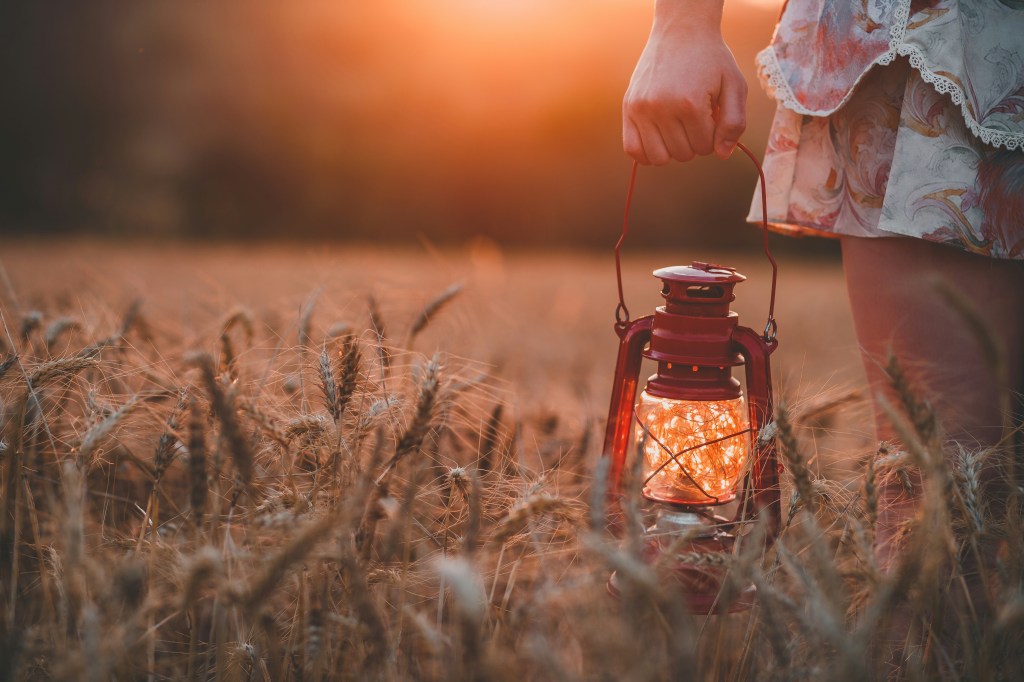
    Up ahead, the light grows larger. I think we should go back the other way, but now Mom’s stopping for a skinny man in the road holding a lantern. Just a man. The light casts a shadow over his face. “Need a ride, stranger?” Mom says. He slides in the front next to me.

    Now Mom drives squinting into the dark, as if there’s a glare, which there isn’t. No one peeps from the back seat.

    The man’s clothes are too big for him; jeans dried hard on a line, tied with rope at the waist, and a shirt with the cuffs past his wrists. He hugs the door like he’s ready to jump out. He doesn’t smell like anything.

    We drive and drive, the road unspooling before us as if we’ve never been on it before, as if we’re lost, as if people we’ve never met really are making this up as we go along.

    At the bus station, the man thanks Mom in a voice that sounds unused to talking. She hands him something from her purse, and says “God Bless,” which we don’t say at home.

    Before he slides out, he leans into me, his breath hot on my skin. He says, “Girl, you try and grow up kind like your mama,” which I never thought of before.


    SUSAN P. MOREHOUSE’s flash and micros have appeared in Hippocampus Magazine, New Ohio Review, The Dribble Drabble Review, and elsewhere. Her stories and essays have been nominated for Best American Essays, The Pushcart Prize, and Best Microfiction, and she recently was the third-place winner of CRAFT Literary Magazine’s First Chapters Contest.


    Featured image by Guilherme Stecanella, courtesy of Unsplash.

  • “Attica Forke” by Philip Dean Walker

    “Attica Forke” by Philip Dean Walker

    In “Attica Forke,” Philip Dean Walker treats the reader to a sensory experience centered on delicate cuisine and meandering memory—and perhaps, just the tiniest tidbit of self-indulgence. The narrative style is sly and cheeky, but also, lush and generous. Let yourself sink your teeth into this delicious flash fiction and enjoy, enjoy, enjoy.  —Court Harler


    Attica let the penne rest on her tongue. There was a fresh, buoyant, somehow elastic quality to it—the texture was firm, yet also tender. It was a quiet, unassuming pasta. Al dente didn’t quite capture its consistency, but she couldn’t think of any other way to describe it. She had not added any Parmesan cheese (emulsified with a garlic butter finish) because the chef at Scarpetta preferred that his dishes be served “naked,” which meant without any garnish added after they left his kitchen. Attica agreed.

    She rolled the penne around in her mouth. Each vertical ridge seemed to slope down farther toward an even more flavorful taste, the sauce dripping off onto the back of her tongue. A light tomato and basil sauce lent a predictable flavor and it clung nicely to the pasta, but there was something else. Some other elusive flavor. Attica tried to coax it out. There was something spring-like and victorious about the sauce that set it apart from your typical Italian pasta dish. It was innovative, yet still familiar. She concentrated harder, took another forkful, and brought it quickly to her mouth, hoping that a rough, ravenous chew might finally yield the secret ingredient. She bit down and, yes, there it was again, unmistakably.

    The taste seemed perched outside of the normal realm of saucery: that tricky task of concocting a perfectly melded, delectable sauce, something upon which any ambitious chef might stake his entire professional life—getting out of bed quietly in the morning so he doesn’t wake up his wife, coming into the restaurant early in order to amass all the necessary ingredients, the overhead kitchen lights casting a shiny tint on all the stainless steel cookery and on the floors, mopped and waxed to a royal gleam the night before because, undoubtedly, the kitchen must be the cleanest part of any restaurant, a holiness sprinkled over the place, like a recently scoured church, still giving off the lemony smell in a charwoman’s wake; and so he begins, mixing in just the right amount of ground carrots, fresh plum tomatoes, chili powder, celery salt, minced garlic cloves, cumin, dried basil, a pinch of sugar, a hint of oregano for tradition’s sake—not too much though, you don’t want to overplay it like, at first, Attica had thought her grandmother Poli had done with her own sauce, overpowering and invasive as if the Italian Army itself had lathered themselves up in it before boarding one of Mussolini’s fabled trains, before she’d come to actually appreciate Poli’s sauce for being just as obvious and wonderful as the old woman behind it—heated up at just the right temperature, bringing it all to a slow boil, red bubbles sputtering just below the placid surface, to get all the ingredients talking to each other in a language they all knew, a conversation to which they were all contributing equally, the sonorous language of the sauce, this sauce, with its goldenrod aftertaste—was that it?—its sweet, playful flavor, a taste that was almost like a garden after a warm late spring rain, the kind of gentle storm that comes abruptly out of nowhere on a sunny day and leaves behind it the flowers dewy and glistening; it was almost…rosy.

    The chef must have infused the oil for the sauce with rose petals. Rose petals and maybe even some currants? That was it, she was almost certain of it. How exquisite. Penne with rose petal-infused oil tomato and basil sauce.


    PHILIP DEAN WALKER is the author of At Danceteria and Other Stories, Read by Strangers, and Better Davis and Other Stories, all of which were named Kirkus Reviews Best Books of 2017, 2018, and 2021, respectively, with all receiving starred reviews.


    Featured image by Empreinte, courtesy of Unsplash.

  • “Fifteen Shades of Pink” by Christine H. Chen

    “Fifteen Shades of Pink” by Christine H. Chen

    In this sweet satire of a flash fiction, Christine H. Chen asks her readers to rethink the color pink. Put yourself in the “Pink Panther heels” of the “Chinatown girls,” and then ask yourself why society asks young women, especially young women of color, to be so cutely monochromatic? Chen poses this serious question in a way that playfully demands an answer.  —Court Harler


    Chinatown girls dream of poster Barbie Pink in a mermaid emerald skirt who whirls on her Hot Pink seahorse with bobbing Baby Pink jellyfish, carpets of jade waves weaving on her Blush Pink seafloor; China Rose pearls caress her Salmon Pink skin, her chest twinkles with Flamingo Rose cockles oh how Chinatown girls pine for Barbie Pink’s blond curls, how Chinatown girls bleach their black hair to yellow goldfish, how they nibble on white rice to carve curves, paint eyelids and cheeks Barbie Pink, line lips Neon Pink, how they squeal oh-my-god to each other when they wear tiaras of Crêpe Pink cloudy beads with plastic Piggy Pink peonies, how they strut imaginary catwalks on Pink Panther heels, Peach Pink conch and Punch Pink jingle shells jiggle on bony hips, their footprints like Ballet Slipper Pink limpets clinging to evanescent TikTok dreams wind blowing on sand, oh how Chinatown girls dream of Barbie Pink who gazes on from her Pastel Pink poster until paper turns to puffs of planet dust.


    CHRISTINE H. CHEN was born in Hong Kong and grew up in Madagascar before settling in Boston where she worked as a research chemist. Her fiction has appeared in CRAFT, SmokeLong Quarterly, Space and Time Magazine, as well as the Best Microfiction and Best Small Fictions anthologies.


    Featured image by Girl with red hat, courtesy of Unsplash.

  • “House Rules” by Jeff Harvey

    “House Rules” by Jeff Harvey

    Some of the best flash fiction is haunted flash fiction. “House Rules” by Jeff Harvey is shadowed by the twin spectres of childhood abandonment and abuse. The piece is driven by a coolly deceptive voice that descends from the darkness; the tone hits as supernaturally chilling, but the horrifying situation itself: all too devastatingly real.  —Court Harler


    Keep your shit locked up. Can’t trust nobody around here. Miss Kendall is okay, but she’ll hit you sometimes after she’s had too many beers. And don’t fucking cry, you’ll get it worse from the others, especially Wayne; stay away from him. Dinner always at six-thirty. Tomorrow’s Saturday so after cleaning the house and laundry, we might get to see a movie on a VHS player. Last week we watched The Breakfast Club. It was cool but nobody famous. After the movie we got lemon cookies and raspberry Kool-Aid. Miss Kendall was happy about something; I’d never seen her smile before. I got some oxy that’ll help ease the pain if you want some. Only ten bucks. And don’t ever ask about going home. That place doesn’t exist for kids like us. Only another house to bide our time.


    JEFF HARVEY lives in Southern California and edits Gooseberry Pie Lit Magazine. His fiction has been published recently by Ghost Parachute, Your Impossible Voice, and Bending Genres. His work has been nominated for Best Microfiction.


    Featured image by Nathan Wright, courtesy of Unsplash.

  • “Tar Pits” by Meg Pokrass

    “Tar Pits” by Meg Pokrass

    In “Tar Pits,” award-winning flash-fictionist Meg Pokrass takes us on a bittersweet ride in a pink convertible —only to discover that fame, like any other earthly accolade, can sink you, and your sister’s “skinny smile,” to the lowest depths. “Tar Pits” is a dexterous, provocative exploration of what it means to be a woman in the world today.  —Court Harler


    First time my big sister took me to the La Brea Tar Pits, we met an out-of-work actor wearing a wilted expression. “You’re my hope,” he said, as if he were sinking. She beamed him her smile, autograph pen in hand. “Don’t give up on your dream, my friend,” she signed, feeling funny for being spotted at the grave of the La Brea Woman’s skeleton.


    Wrapped in faded denim, my big sister’s middle-of-the-night skeleton drove us again to the tar pits. She was pretty, nobody knew she was funny. “You locked in the part,” said her agent, “because of that skinny smile.” I imagined him bowing to kiss her hand but accidentally pinching her bottom. She was soaring over pitch-black places where other actresses were sinking.


    “She was eighteen years old when she died there, asphyxiated while sinking,” she explained, nibbling carrots. Deep in her bathtub, I’d stare at my twelve-year-old skeleton. I wanted to tell her it was a bad idea to revisit those tar pits. “I can feel you wrinkling!” she’d say, rushing in, grabbing my hand, pulling me out. “I’m your La Brea Woman,” I’d sing, wanting to be funny. 


    “When playing a role, an actress is no longer a skeleton,” she said. That day her eyes were bloodshot and we were eating lettuce straight from the bag. When she got bad news after a big audition, I held her hand. The two of us worked up our skinny smiles in the mirror before hopping into her pink convertible. “You used to be funny, kiddo,” she said, as if I were the one who was sinking.


    Not every girl has a sister who haunts old tar pits, I told myself. Now thirty, her agent dropped her and she was sleeping. I was a teenager with undeveloped features, beginning acting lessons. “Disappearing is recommended if it keeps you famous,” she’d say in her pj’s, popping a NoDoz before falling back asleep again.


    No longer a skeleton, she was eating everything she wanted, and it was almost funny. “Let’s binge on donuts,” she’d suggest, pulling me by the hand. One time we ordered twenty maple donuts at Zucker’s, our stomachs rising and sinking. “Relying on anyone,” she warned me, “is dying in a tar pit.” 


    Now I’m driving Hollywood Boulevard in my sister’s car, proud of my skeleton. When I find myself wallowing in memories, I stop for donuts or drive past those tar pits. She left me her pink convertible, and with my hands on the steering wheel, I feel myself rising.


    MEG POKRASS is the author of First Law of Holes: New and Selected Stories (Dzanc Books, 2024) plus eight previous collections of flash fiction and two novellas-in-flash.


    Featured image by Cash Macanaya, courtesy of Unsplash.