In “May the Circle Be” by Maximilian Martini, readers of this flash fiction are asked to consider unspeakable tragedy. How does the survivor survive, day by day, only going “round and round and round,” endlessly circling her incomprehensible grief? A laundromat’s washers and dryers come to symbolize the cycle of life, the horrifying futility of living and dying. —Court Harler
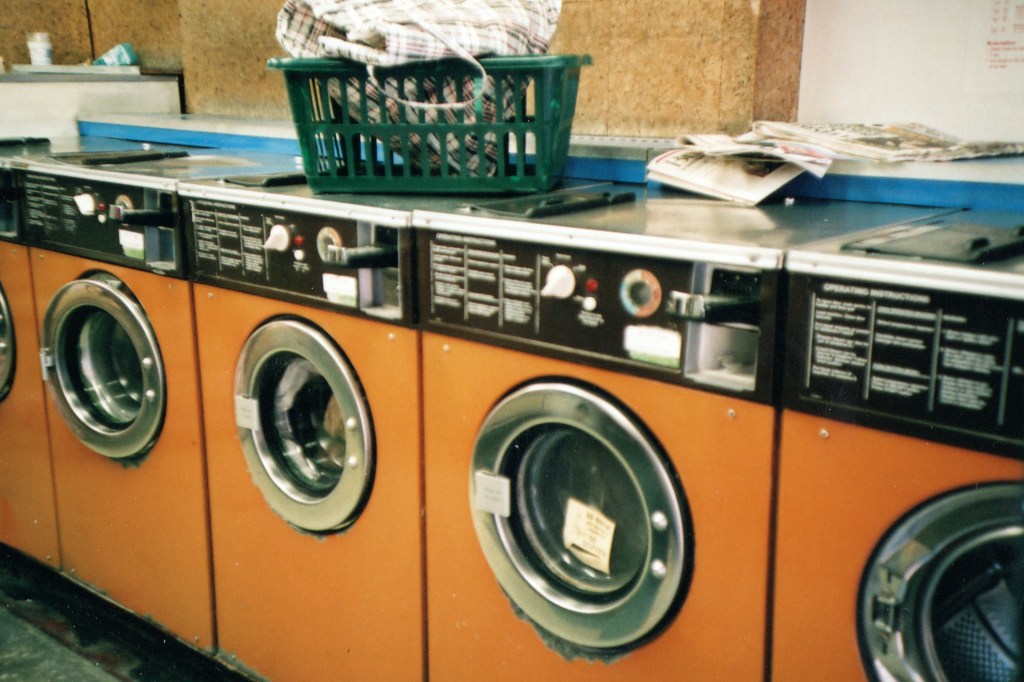
Her stomach is open as her wide-opened eyes. Laundry takes all night. The windows are walls that double the room, making two dozen washers and dryers, echoes of echoes. Her four dollar bills transform into a box of soap and suds in hot water that spins and spins. It takes her two machines to clean her clothes and his clothes and the baby’s cutesy little outfits, pink and white and soft. The baby didn’t have a lot of clothes. She was supposed to outgrow them so fast. They will be clean now. They shouldn’t be dirty ever again. Dirt comes in, dirt goes out. Stains come to stay. Money only ever goes out. Life should be so clean. Making a lesson of it doesn’t help.
The wreck made standing hurt. Plastic chairs are nailed to the floor. Sitting in them grinds her busted discs. The man sleeping on the couch has a bad smell. Dust bunnies congregate everywhere in pools of detergent except right before her washers, spinning and spinning, hurricanes on the weather channel, crossing her eyes. She sits on the floor with some relief.
She scoots in toward the washer on the left. One at a time is better. One is all it takes to be completely in love. Clothes smash against the drum. They’ll never get out that way. You have to lean in.
The round window of the washing machine is warm and resonant against her forehead. This close, the spinning clothes take up everything: white and dark blue and the littleness of pink. Yawning had become blinking and then honking and screeching, the windshield exploded and then they were all spinning against each other, all three of them bouncing around the truck, between the walls, colliding like shoes in a dryer of metal and wheels and bones, tiny baby bones, colliding straight from the earth to death.
A bell chimes overhead. Her eyes pop. Sleeping guy is gone. She’s more alone.
One time, just once, she bangs her head against the glass on the door of the washing machine. Her neck aches and her discs grind. There’s something good about it, though, like parts sliding into place. The clothes go round and round.
One time, just one more time, harder, she bangs her head. There’s too much noise to hear anything. Round and round and round.
One more time now she throws her forehead into the machine. Her body goes through the circle of glass, first her head and then her shoulders, which drag in her busted discs and dirty legs and all of her ruined body into the wide-open drum. The water is warm and the clothes are soft, spinning, unbreaking, grasping at every loose arm, every tiny beanie and sleeper, tangled in his coveralls and her scrubs and the baby’s little onesies and pink booties that she’ll never wear again, they’re all together, more folding than breaking, more drowning than breathing, she’s very nearly through, almost in.
MAXIMILIAN MARTINI writes, teaches, and sings in Chattanooga, Tennessee. His work has been published by Bending Genres, trampset, Walnut Street Publishing, and FlowerSong Press, among others. He is an artist with River to River Community Records.
Featured image by Scott Evans, courtesy of Unsplash.