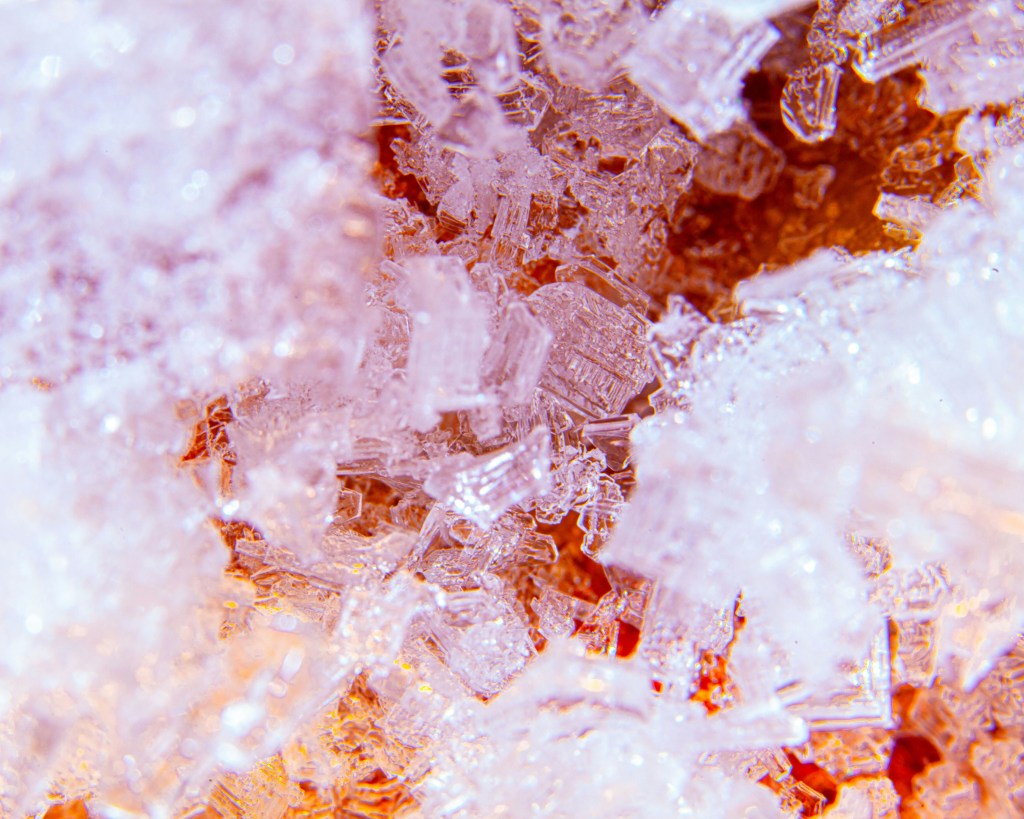
Tag: Speculative Fiction

  • “The Girl Who Broke Every Omen” by Hana Xen

    “The Girl Who Broke Every Omen” by Hana Xen

    In “The Girl Who Broke Every Omen,” Hana Xen lends new nuance to the objective correlative. Omens of folklore are reframed as their literal objects, instead of their actions or outcomes: broken mirrors, spilt salt, dead crows, and fallen ladders. Xen’s narrator invites the reader to explore the possibilities beyond the traditional conception of superstition.  —Court Harler 


    The first omen I broke was a mirror, and I swear it screamed.

    A thin, silver sound, high and startled, before the glass webbed into fractures. My reflection split into a dozen versions of me, each one staring with a different expression: warning, pity, hunger. One shard caught the light just right and made a tiny rainbow across my wrist. It felt almost deliberate.

    I should have looked away.

    I leaned in.

    Bad luck did not come.

    Something else did.

    The next omen was the salt. The shaker toppled from my hand, spilling white grains in a crooked, broken circle. A boundary. A warning line.

    I did not throw any over my shoulder.

    I stepped through it.

    Something stepped with me.

    At first it was only a second set of footsteps, slightly behind mine. Then a breath on my neck when I turned off the lights. On the third night, I saw her in the corner. Girl-shaped but wrong. Spine bent. Fingers too long. Eyes reflecting moonlight like wet stone.

    Not a ghost.

    Not me.

    Not not me.

    She pointed toward the window.

    A crow lay there the next morning, neck snapped clean, wings arranged like an offering. No blood. No struggle. As if it had been removed carefully from the sky.

    After that, omens cracked around me like knuckles.

    The ladder in the alley fell the moment I passed beneath it.

    Doors sighed open before I touched them.

    Streetlamps guttered when I smiled.

    People began stepping away from me in public. They did not know why. Instinct, maybe. Animals sense rot before it blooms. My stomach twisted sharply the first time someone flinched from me. I told myself I was fine. I probably wasn’t.

    Then the moon split itself open, rending into a thin crescent. A curved blade hanging above the rooftops. The night went still. Even the thing in my corner held her breath.

    She was not haunting me.

    She was studying me.

    Growing clearer each time an omen broke.

    Growing closer.

    The holy water incident happened after a stranger saw something behind me. He flung the bottle at my feet like he was trying to snuff a fuse.

    It burst.

    The mist rose cold and metallic.

    The girl inhaled.

    The man’s face twisted. He ran without looking back.

    I did not chase him.

    I turned to my shadow instead.

    I should have run.

    She smiled with all my teeth.

    I break omens now because they break first.

    Because something in me is waking.

    Because warnings were never meant to save girls like me.

    Only to announce us.


    HANA XEN writes mythic and historical fiction shaped by folklore, from eerie flash to hybrid narrative prose. Her work has been long- and short-listed in writing contests and appears in anthologies and literary e-zines. She believes folklore isn’t superstition but documentation, and lives in the Midwest with a healthy skepticism of both curses and social media.


    Featured image by Jeroen van de Water, courtesy of Unsplash.

  • “She won’t survive this” by Salena Casha

    “She won’t survive this” by Salena Casha

    In “She won’t survive this,” Salena Casha artfully blends speculation and personification, interiority and exteriority. We might also mention elements of post-apocalyptic flash fiction, though readers will encounter very little “post” in this environmental apocalypse, except for nameless “mutants,” endless “shades of tan,” and one last courageous soul.  —Court Harler


    In her time, she’d known storms, but not like this with all its shades of tan. Clay on canvas, camel hair on Gobi dunes, clouds choking on their own dusky exhaust. The winds made the brackish water in her ribs tremble. In the 2340s, she’d sacrificed her outgrowth pads and threaded her roots between the salt plank grains of Earth’s changed topsoil. Just to keep her in one place, even if it was Ohio. 

    For comfort, she thought about how she’d outlasted humans. How those chlorophyll-less mutants ill-governed what sunlight there was left behind window slats. Her ancestors had complained about millennial plant parents and their inconsistent watering cans, but she’d always found them innocuous, if sadly misled, beings. Some of them, the scientists mainly, said cacti would never grow in Cleveland. All wrong, all gone. Sure, she was alone, but she still counted.

    Well, that wasn’t entirely true. Once, someone said that cockroaches would survive the apocalypse, but they hadn’t thought about snails. Those land crustaceans with their spiraled shells and belly mucus. A decade ago, one had chosen to circle her roots. Every day, she watched them collect gravel. They’d been particular, choosing chipped detritus in camphor speckled with chartreuse, chrome veined with cherry. Slate and canary and emerald sea glass. She hadn’t realized what they were doing until one morning, they took their collection and stacked the stones like bricks on their entrance. Walled themselves inside and never came out. Their tomb stayed beside her, too heavy for the wind, and on days when a sliver of sun pierced the landscape, she watched the light play off its self-made stained glass, a spiraled church in miniature.

    So, no, she hadn’t always been alone. 

    The day of the storm, she hunkered down more than she’d hunkered down over the decades gone, her grips tightening around the hallucination of loamy soil. It was one of those feelings that never left her, after all these years, the sticky particles of wet Earth. She pretended that below her, worms still sifted the Earth’s layers. The air picked at her, but she held fast. She couldn’t see the snail’s shell through the percolated landscape and panic thrummed through her. She was tired. Old, beyond measure. As the gusts enveloped her, she let herself whisper it aloud. 

    Maybe I’ve fought enough. 

    While she’d wondered it before, she wasn’t sure she’d meant it this time more than times past. The air roiled, full of what she’d put into the universe and the ground slipped beyond her and she wasn’t sure if she let go first or the Earth finally became slick as a bald pate. Somehow, the wind lifted her, shredding her anchors into silk dust. As it swept her up, away, elsewhere, she thought about how she could change again. Become a bird. Or, maybe, something else entirely. 

    Perhaps even become the light that flickered through azure glass.


    SALENA CASHA’s work has appeared in over 150 publications in the last decade. Her most recent words can be found in HAD, Metaphorosis, and Flash Frog. She survives New England winters on good beer and black coffee. Subscribe to her substack at salenacasha.substack.com.


    Featured image by Pete Godfrey, courtesy of Unsplash.

  • “Inconclusive” by Jack Smiles

    “Inconclusive” by Jack Smiles

    Flash fiction can (and will) run the gamut of human expression. In “Inconclusive,” Jack Smiles utilizes dry humor and sparse but surprising prose to keep the reader riveted until the very end. The overall mood is playfully noir—dark and twisty but also funny and, ultimately, hopeful.  —Court Harler


    My father always said he was a WASP, as in White Anglo-Saxon Protestant, or so I thought. He had no family anyone knew of. He disappeared when I was sixteen, literally, poof, gone. I was curious as hell about him. For my twenty-first birthday my girlfriend gave me a DNA test kit. I learned I was fifty percent Irish, which I expected from my mother’s side, but the other fifty percent? 

    “Inconclusive.”

    Inconclusive? I talked to cousins on my mother’s side who had done the test and none of them had ever heard of inconclusive. I called the 1-800 number, but ran out of patience after the fifth voice prompt. I sent emails, a web form and a letter, that’s right, paper, envelope and stamp. 

    I was seriously thinking about driving to Omaha and camping out in front of the office of the DNA company until someone gave me an answer. But it didn’t come to that. I got a text from a restricted number: 

    “Jane Reilly. Postum, New York. 611 Crandell Street. Inconclusive.”


    611 Crandell was a six-story apartment building. I didn’t have an apartment number. I stepped into the foyer. The door to No. 1 opened. If this was Jane, I hoped to God we weren’t related. She was gorgeous. Tall. Blood red hair. Enormous green eyes. I had red hair and green eyes, too, but nothing like hers.

    “Jane?”

    “Inconclusive. Come in.”

    We sat on stools at the counter bar in her kitchen. She poured wine.

    “Are you drawn to strange things or have odd habits?” she asked.

    I didn’t admit it, but yes. I liked aphids. I never knew why, but I collected them in a glass jar that I kept in the laundry room and watched their tiny black or green bodies shrivel as they died.

    “Do you sleep outside?” 

    Again I couldn’t admit it, but again she was right. I did sleep outside a lot, sometimes in a hole.

    “You are drawn to bright light, aren’t you, and deathly afraid of webs?”

    “Well, we’re all unique.”

    “Unique, indeed,” she said. “Follow me.”

    I’d follow her anywhere.

    We took an elevator to the roof.  She walked to the back edge of the building. We stood side by side looking down at an empty alleyway.

    “We have the same great grandfather,” she said. “He was from….”

    I didn’t hear where he was from. She’d pushed me off.

    So this is how I die, I thought as I fell, and I was so close to discovering my heritage. But my body orientated in midair. My fall slowed. I landed gently on my feet. I looked up. Jane gave me a come-here gesture. My arms went up from my sides. They quivered, faster and faster, making a buzzing sound. I lifted off the ground and flew, floated really, in a meandering pattern back to the roof.

    My father, I realized, really was a WASP.


    JACK SMILES is a former community newspaper feature writer collecting freelance rejections as a hobby in retirement.


    Featured image by Ali Bakhtiari, courtesy of Unsplash.