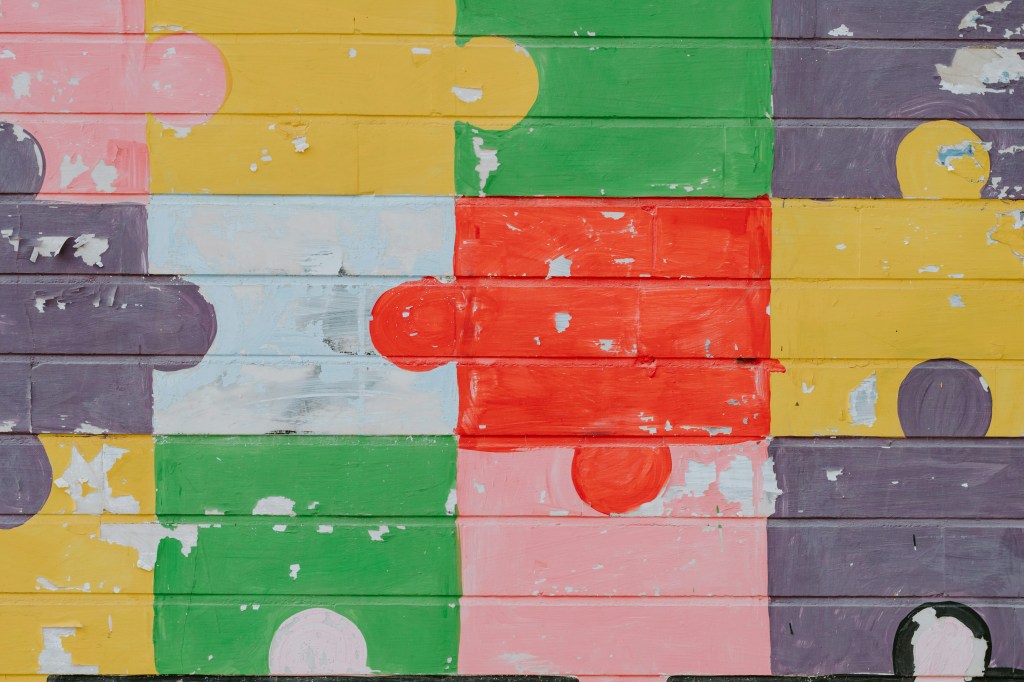
“The day they bomb the art gallery” by Belinda Rowe is a flash fiction with the beating heart of a prose poem. Note certain poetic techniques, such as the well-placed repetition of the “enigmatic smile.” Or how the images of color burst upon the page in fits of sensory delight. The narrative itself is a puzzle that both resists and relishes its completion. —Court Harler
I sweep up a scrap of canvas with a woman in a bright-blue robe being abducted by a soldier. My sister picks up the intact face of an unremarkable woman. People are looting scraps of Poussin, Raphael, Renoir, Géricault, da Vinci, Matisse, Caravaggio, Delacroix. Art is jigsaw. Art is carried on the wind – my sister and I are swept up in the fervour.
Our mother’s at home when she hears the news and calls. Are you both okay?
A man on a raft waving a scrap of red-and-white fabric sails past us on the wind. Buildings collapse, ravens caw, the air is acrid.
Art is everywhere, I shout. Emile found a young woman’s face –
– describe her, our mother urges.
She’s nondescript – black shoulder-length hair, dark eyes, long nose, an enigmatic smile.
Is she painted on canvas? our mother whispers, as if someone might hear.
Wood –
– quick, put her in your backpack, don’t let anyone see you.
The streets are filled with people stuffing sacks with splinters, details, fragments of Naples yellow, vermillion, carmine, azurite blue, malachite, bone black. We step over marble limbs, the torso of a bare-chested woman carrying a blue, white, and red flag, then slip through a storm drain into the catacombs, wend our way home along dark, dank passages, our phone torches lighting the way.
On the black market and the dark web, people trade art, barter for potatoes, cheese, bread, offer cash, whatever they have. People want to reconstruct: ‘Has anyone found John the Apostle and Judas from The Last Supper? I’ll trade you for a scallop shell with the feet and legs of Venus.’
We decorate our houses, workplaces, car windows: a philosopher meditating, swirling clouds, stars, a crescent moon, Aphrodite’s marble head, a pearl earring, tiny skaters on a frozen pond, sunflowers, a young lacemaker peering at her work. People wear fragments of canvas, marble, and jade around their necks; fashion hats, trousers, sundresses from medieval clothing. Someone puts an intact porcelain urinal in their loungeroom window.
I search for the poplar-wood panel depicting the sixteenth-century dress – raven black, elegant, simple, possibly silk with subtle gold embroidery – that belongs to the woman with the enigmatic smile. When no one replies, I make quick work detaching the woman dressed in the bright-blue robe from the soldier abducting her, trade him for a piece of poplar-wood panel and oil paints, enough food for two years.
I set to cutting, splicing, gluing the woman with the enigmatic smile onto the piece of poplar-wood panel – apply lead white pigment, blacks, browns, greens – bring her chest, her low-cut bodice, her dress, her right hand resting on her left wrist, to life, a blurred soft smokiness. Art is compulsive, tenacious. Time contracts, my fingers smooth, blend, layer. We aren’t flies you can squash, I whisper.
BELINDA ROWE is an emerging short-fiction writer. Born in Aotearoa (New Zealand) she now lives in Walyalup (Fremantle), Western Australia. Her recent fiction appears in Unbroken, Literary Namjooning, Fractured Lit, New Flash Fiction Review, and Vestal Review. She was a SmokeLong Quarterly Emerging Writer Fellow in 2025.
Featured image by Ashkan Forouzani, courtesy of Unsplash.

 Flash the Court