Author: Court Harler

  • “Twenty-One Grams” by Carolyn R. Russell

    “Twenty-One Grams” by Carolyn R. Russell

    “Twenty-One Grams” by Carolyn R. Russell is a speculative flash fiction that never quite relinquishes its sense of mystery. The setting is reminiscent of the fevered religious revivals of olden days, but Russell cheekily infuses both the plot and the perspective with an otherworldly, new-age sensibility: souls are “weighed” but also consoled by a “perky college girl” with Hello Kitty Kleenexes. Readers will long ponder this narrative’s final reckonings.  —Court Harler


    Our host has a pointed beard that metronomes back and forth as he describes the ancient means by which he says human souls can be weighed and measured. Twenty-one grams, he gargles out, his spackled eyes half shut. Tonight he’s barely bothering to hide his disdain; I should have adjusted the footlights to soften the contempt that rolls off him in waves.

    While he lectures, before a transaction, he never moves from behind the podium on the raised platform. We tried that once and it was a disaster; our host in motion was too much for the crowd, resulting in bleeding eyeballs and aneurisms that left our marks incapable of consent. Something about the way he moves is impossible to disguise inside any kind of gear or clothing.

    He begins to hit his stride now; centuries of practice guide the rhythms of his pitch. The room is warm and ripe with the sharp stench of cortisol and adrenaline despite the December air blasting through the open windows that showcase the White Mountains of New Hampshire. Twenty-one grams, he hisses, only twenty-one grams, the weight of a mouse, or a fava bean, or a double-A battery. That’s it!

    As he talks I roam the carpeted periphery of the auditorium. That’s me, a perky college girl with a short skirt and an empathetic smile, quick to offer vitamin water or Hello Kitty Kleenex. I watch and listen. This part can be tricky.

    A woman sitting near me to my right starts to speak. I approach her and ask her to stand and direct her question to our host. She asks if partials are acceptable. Like we’re talking about a liver, like maybe she thinks it will grow back whole. I smile and put my hand on her shoulder to ease her back into her chair, and there it is. That electric jolt that travels up through my wrist and singes my eyelashes.

    We’re finished here.

    I nod to our host and he is before her in an instant; later no one will remember his elated stroll down the aisle. He extends to her a surprisingly dainty hand; he knows how delicate are these first moments of desire, of decision. The woman rises; he puts his arm around her waist and walks her back up the aisle toward the lectern, his new catch a vision in Lilly Pulitzer florals.

    As soon as our host’s back is turned there is the usual stampede for the doors. It always makes me laugh. A teenage boy looks at me over his shoulder as he runs. I place a closed fist on my chin and then raise my index finger straight up over my lips; the boy flings a different finger in my direction, the whites of his eyes lacey with red veins like a road map to hell. We’re in town another few days, and I wonder if he’ll be back.


    A Best Microfiction winner and a Pushcart Prize, Best of the Net, and Best Small Fictions nominee, CAROLYN R. RUSSELL’s short stories, poetry, and creative nonfiction have been featured in numerous publications. Her collection of cross-genre flash is called Death and Other Survival Strategies (Vine Leaves Press, 2023).


    Featured image by Roman Kraft, courtesy of Unsplash.

  • “The Girl Who Broke Every Omen” by Hana Xen

    “The Girl Who Broke Every Omen” by Hana Xen

    In “The Girl Who Broke Every Omen,” Hana Xen lends new nuance to the objective correlative. Omens of folklore are reframed as their literal objects, instead of their actions or outcomes: broken mirrors, spilt salt, dead crows, and fallen ladders. Xen’s narrator invites the reader to explore the possibilities beyond the traditional conception of superstition.  —Court Harler 


    The first omen I broke was a mirror, and I swear it screamed.

    A thin, silver sound, high and startled, before the glass webbed into fractures. My reflection split into a dozen versions of me, each one staring with a different expression: warning, pity, hunger. One shard caught the light just right and made a tiny rainbow across my wrist. It felt almost deliberate.

    I should have looked away.

    I leaned in.

    Bad luck did not come.

    Something else did.

    The next omen was the salt. The shaker toppled from my hand, spilling white grains in a crooked, broken circle. A boundary. A warning line.

    I did not throw any over my shoulder.

    I stepped through it.

    Something stepped with me.

    At first it was only a second set of footsteps, slightly behind mine. Then a breath on my neck when I turned off the lights. On the third night, I saw her in the corner. Girl-shaped but wrong. Spine bent. Fingers too long. Eyes reflecting moonlight like wet stone.

    Not a ghost.

    Not me.

    Not not me.

    She pointed toward the window.

    A crow lay there the next morning, neck snapped clean, wings arranged like an offering. No blood. No struggle. As if it had been removed carefully from the sky.

    After that, omens cracked around me like knuckles.

    The ladder in the alley fell the moment I passed beneath it.

    Doors sighed open before I touched them.

    Streetlamps guttered when I smiled.

    People began stepping away from me in public. They did not know why. Instinct, maybe. Animals sense rot before it blooms. My stomach twisted sharply the first time someone flinched from me. I told myself I was fine. I probably wasn’t.

    Then the moon split itself open, rending into a thin crescent. A curved blade hanging above the rooftops. The night went still. Even the thing in my corner held her breath.

    She was not haunting me.

    She was studying me.

    Growing clearer each time an omen broke.

    Growing closer.

    The holy water incident happened after a stranger saw something behind me. He flung the bottle at my feet like he was trying to snuff a fuse.

    It burst.

    The mist rose cold and metallic.

    The girl inhaled.

    The man’s face twisted. He ran without looking back.

    I did not chase him.

    I turned to my shadow instead.

    I should have run.

    She smiled with all my teeth.

    I break omens now because they break first.

    Because something in me is waking.

    Because warnings were never meant to save girls like me.

    Only to announce us.


    HANA XEN writes mythic and historical fiction shaped by folklore, from eerie flash to hybrid narrative prose. Her work has been long- and short-listed in writing contests and appears in anthologies and literary e-zines. She believes folklore isn’t superstition but documentation, and lives in the Midwest with a healthy skepticism of both curses and social media.


    Featured image by Jeroen van de Water, courtesy of Unsplash.

  • “Liturgist of the Land: A Single Work Completed” by Gregory Ormson

    “Liturgist of the Land: A Single Work Completed” by Gregory Ormson

    In his lyric essay, “Liturgist of the Land: A Single Work Completed,” Gregory Ormson pairs the philosophical with the practical, the conceptual with the concrete. While he ponders the lofty lessons of Greek myth, he also contemplates the gritty necessity of burial. In these parallels, Ormson finely illustrates what he calls “finishment,” even if it remains elusive.  —Court Harler


    Look around. People are constantly checking their cell phones. Something must be left undone. A complete fucking incompleteness, a permanent, angst-driven scratch. Sisyphus whined, “In this rhythm, I am caught.” Push the stone up the mountain. Check the phone.

    Does anyone experience a single work completed? A work so perfectly done that it could be called an existential tetelestai, a complete eschatological-level finishment. I saw it once, a work completed that could not be improved. Here is the work indexed:

    Dig.

    Dump.

    Bury.

    Cover.

    Nothing decorative. Nothing symbolic. Everything necessary.

    Burial is not in my will, but I can pretend it is. Play with me here. See one gravedigger standing above my body, boots planted in sacred ground, cigar at his mouth. Before the last shovel of earth is tipped over me, he flicks the cigar down into the hole and covers it. Then he dusts off his hands, spits once, and walks away. One work completed that day. If I were still alive to know it, I would be satisfied with his work. He would not call it a ritual. He would not name himself a priest. But the land would know.

    Some people serve as liturgists without learning the title of their work. I saw another version of that same work with my friend Baker in Big Bay, Michigan, when we dug down eight feet into the earth with a spade.

    In the middle of our work, he stopped to catch his breath. “It’s got to be deep, so the skunks don’t dig it up and spread it around the campground,” he said.

    Tipping a blue barrel of fish remains into the hole, gathered from the campers at his resort, I looked at the slimy cathedral of eyes, bone, and skin. Walleye and crappie, bass and perch. Death and life piled up together in stink and shine.

    Baker stirred the goop in the hole with a stick, handed the stick to me and said, “Here. Mix it up.” I stirred the smelly goo while he added sand and water. “Yuck, that stinks,” the children said. They hated our cigars too.

    The smelly alchemy of fish, sand, water, and flies animated his conviction that the whole creation was right there in that hole. “Is this a metaphor for our life on earth, foam stirred by another master?” Baker said.

    Brushing up against the mystery of life in that hole by Lake Independence, I wondered if Baker was an alchemist in a past life, a man to whom the search for the philosopher’s stone was never completed. The seminarian interrupted, apprenticed to decay…yet still busy sniffing out divinity’s lessons in the alchemy of decomposing flesh in bubbles of methane and carbon dioxide.

    Over the years, I have learned how sacred ground is formed. The cabin floor, worn thin by feet and years. The red-handled pump that once squealed loud enough for people across the lake to hear us collecting water for morning coffee, now stilled. The graves of Sitting Bull and Sacagawea where engines fall silent into the space of awe and attention. The Red Desert, holding my medicine bowl of the vision quest where only breath moves. And the prickly desert where a girl vanished, and neither the ground nor the courts have finished the work.

    Different soils. Same covenant.

    I am counting on fire to take my body and my phone. No more scrolling. No more unfinished messages. No more stone to push back uphill. But one last time, I let myself imagine the liturgy in land, the older grammar, older than signal and screen:

    Dig.

    Dump.

    Bury.

    Cover.

    A shovel.

    A cigar.

    Another burial under the thin skin of the Earth, where the sacred ground seals our relinquishment. And the last act, releasing what is always borrowed and rented. But, at last, no more Sisyphean grind, just one single work,
    completed.


    GREGORY ORMSON is the author of Yoga Song, Rochak Publishing (2022) and Lantern Audio (2023). “Midwest Intimations” was his winning longform lyric essay in Eastern Iowa Review’s Maggie Nonfiction Award (2016). He was also awarded Indiana Review’s thirteen-word story contest prize (2015).


    Featured image by Sašo Tušar, courtesy of Unsplash.

  • “Ben Stiller’s Friend Flipped Me Off at a Restaurant in New York City” by Rachel M. Hollis

    “Ben Stiller’s Friend Flipped Me Off at a Restaurant in New York City” by Rachel M. Hollis

    “Ben Stiller’s Friend Flipped Me Off at a Restaurant in New York City” is quite a long title for a rather short story. A microfiction, in fact. In 140 words, Rachel M. Hollis tells the immersive tale of an urban love affair, partially set in an “apartment, both cramped and impossibly empty.” And while the title may seem flippant, the narrator is anything but insincere.  —Court Harler


    Because I tried to take a sneaky picture of them on my BlackBerry. Blurry, lopsided, famous.

    Before Ben Stiller’s friend flipped me off at a restaurant in New York City, my boyfriend and I were arguing on West Forty-Sixth Street. He loved that the city never slept and I couldn’t remember the last time I had.

    Before we were bickering on a busy street, we were staring at our phones in our Williamsburg apartment, both cramped and impossibly empty.

    I didn’t realize what had happened until we got home and I opened the photo. Ben, ignoring us. His friend’s middle finger—perfectly in focus.

    “I still can’t believe we saw Ben Stiller,” he said, like it meant something. Like we’d had a moment.

    I packed a bag and left while he was still staring at the photo. He never looked up.


    RACHEL M. HOLLIS lives in the San Francisco Bay Area with her husband, child, and a deeply unmotivated dog. Her work appears or is forthcoming in River Teeth’s Beautiful Things, Midway Journal, Lost Balloon, Gone Lawn, Necessary Fiction, and elsewhere.


    Featured image by Wes Hicks, courtesy of Unsplash.

  • “Beth” by Shell St. James

    “Beth” by Shell St. James

    “Beth” by Shell St. James could be a contemporary, albeit chaste, roommate romance, but the narrator’s slightly elevated tone suggests otherwise for this flash fiction. In four dramatic scenes artfully condensed to their very essence, St. James utilizes poignant detail and evocative imagery to depict an indelible setting and deliver an unexpected storyline.  —Court Harler


    The first time I saw Beth, she was dragging her luggage through my front door, cursing like a sailor as the suitcase got caught on the threshold.

    “May I help you with that?” My lips twitched as I tried to hide my amusement.

    She pointedly ignored me, a spirit of fierce independence evident in her scowl. Palms up, I backed off and watched her struggle, squashing down my impulse to take the dratted case out of her hands.

    The second time I saw Beth, she was sipping a glass of Merlot, listening to my favorite piece by Chopin, with her eyes closed. I stood in the shadowed corner of the study, quietly observing, as the music inspired her to rise from her chair and dance barefoot across the room. I fell in love with her as the candlelight lit her face, her auburn hair swirling in a fiery cloud, her graceful limbs fluid and expressive, painting the air.

    That night I crept into her bedroom as she slept, unable to resist the temptation to touch her. I gently stroked her cheek, wishing I could confess my feelings.

    Her eyes flew open in alarm, and she bolted upright in a panic.

    Ashamed, I fled the room, retreating to the attic.

    The last time I saw Beth, she was packing her things, intent upon leaving. I broke down and wept, begging her to stay, but she looked right through me. At the door she turned back warily, her fearful eyes scanning the empty front room.

    “Please don’t follow me,” she whispered. “Rest in peace.”


    SHELL ST. JAMES is an author and artist living in an 1895 farmhouse in the foothills of North Carolina. Her short stories have appeared in numerous magazines, anthologies, and podcasts, including Shenandoah Literary Magazine, Sci-Fi Shorts, Night Terrors: Scare Street (Vol. 12), and Creepy Podcast. Read selected stories for free at shellstjames.com.


    Featured image by Peter Herrmann, courtesy of Unsplash.

  • “Precious Alchemy in the Margins” by Denise Bayes

    “Precious Alchemy in the Margins” by Denise Bayes

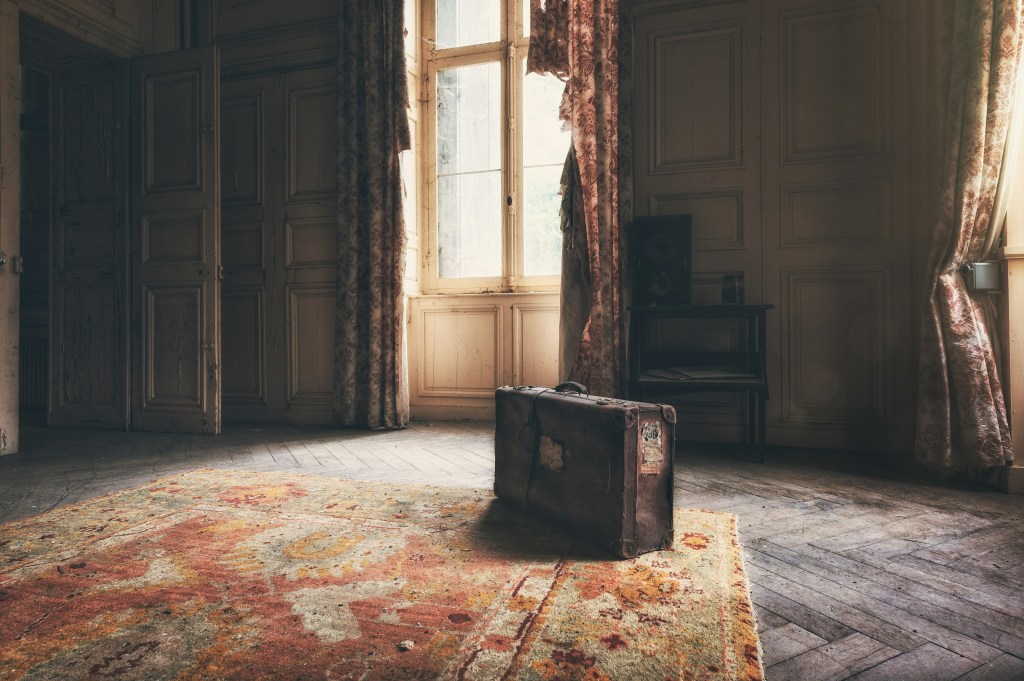
    In her new flash fiction, “Precious Alchemy in the Margins,” Denise Bayes offers the reader a feast for the senses: the warmth of “the fox’s fur,” the slime and slither of the “molluscs,” and the mystical sound of “creatures gather[ed], playing instruments.” And in secret spaces, in “the marginalia” and “the cloisters,” sharp reminders of the unrequited, or the “lured,” refuse to remain unnoticed, shimmering “golden” like tempting treasure.  —Court Harler


    Clever Foxes

    Mosaic gold glints on the fox’s fur, tin and sulphur fused in magic by medieval scribes. I unfold from my study of the manuscript, blink into the darkness of the college library. Memories of my Reynard, the russet warmth of our undergraduate love nest.

    Fighting Snails

    In the marginalia, humans battle slimy molluscs. We always lose to the crafty creatures.

    They remind me of her.

    I remember her arrival at college, a Fresher slithering her way into the midst of our Medieval group, flattering him with her fake enthusiasm for Chaucer. How she listened wide-eyed to his words, flicking flirtatious glances at his golden hair.

    She lured him from me on silver threads.

    Bands of Animal Musicians

    In The Book of Hours, creatures gather, playing instruments. Scholars say they show the world turned upside down.

    My world turned upside down.

    Try for Fellowships, she told him.

    Academia is hungry for your words, she whispered.

    His head turned towards the glittering dream.

    The day they married in the College Chapel, I cloistered in the library until the last chords of dance music died. Trampled home across a carpet of crimson confetti.

    Warrior Women

    Now I head to my study through the quad, past the latest huddle of alumni reliving their glory days in noisy reminiscence under the curve of the cloisters.

    I freeze at the sight of him. My Reynard.

    His hand runs in a remembered swirl through tawny hair, now flecked with grey. My fingertips flinch, recalling the coarse texture beneath my palms. I remember his warm breath against my bare neck.

    He looks up just then, across the courtyard, straight into my eyes. The air shivers golden between us. 

    I step onto the manicured lawn, passing the sign.

    ‘Fellows Only.’

    I know he follows my every footstep.


    DENISE BAYES’s writing has appeared in New Zealand’s Micro Madness, Oxford Flash Fiction Anthology, Free Flash Fiction, National Flash Fiction Day Anthology, 100 Word Story, Thin Skin, Temple in a City, and Underbelly Press. Denise lives in Barcelona, Spain, with her husband and a cavalier called Rory, who is usually under the desk. Find her @deniseb.bsky.social.


    Featured image by kevin laminto, courtesy of Unsplash.

  • “Water Tower Views” by Liz deBeer

    “Water Tower Views” by Liz deBeer

    In “Water Tower Views,” Liz deBeer captures the intricacies of budding young love—it’s both charming and crude, both bashful and brazen. The reader is given a glimpse of young love’s potential future as well, which grows ever more complicated amid fraught family dynamics. Surveillance and supervision also act as key motifs in this bold flash fiction.  —Court Harler


    Pushing aside homemade floral curtains, I watch neighborhood boys bike toward our street’s dead end, supervised only by the town’s water tower, a silver globe atop long legs, like a giant metallic spider.

    The next morning at the bus stop, they laugh and elbow Billy, mimicking him climbing up the long ladder to the water tower’s top railing, swearing it’s over one hundred fuckin’ feet. How Billy spread apart his legs to pee on the wildflowers below, bellowing, “I can see the whole damn world up here!” They shake their pelvises as if they too are spraying Queen Anne’s lace and black-eyed Susans from the heavens. They suck on imaginary cigarettes, blow out phantom smoke puffs, hack from fantasy fumes.

    A few yards away, the other girls and I pretend we aren’t listening, aren’t visualizing a yellow stream watering the wildflower field, aren’t wondering if we could make smoke circles too or if we’d choke-gag-retch at all of it.

    When the bus pulls to the curb, the boys strut down the aisle to sit in back rows, as far from the driver’s view as possible. Sliding into a middle seat, I wonder what else Billy saw from the water tower. Could he see into our houses? Mom yelling at Daddy when he spilled spaghetti on the carpet? Or my older sister smooshed against her boyfriend on the motorcycle Daddy had forbidden her to ride? Or later, Daddy guzzling glasses of Seagram’s Seven and Seven, cursing the goddamn Mets?

    As we bump toward school, I wonder if Billy could see me from my window wishing I were with him, looking out over rooftops, yelling, “I can see too!” Or if he sees me now, thinking of him and the boys.


    LIZ deBEER is a teacher and writer with Project Write Now, a writing cooperative based in New Jersey. Her latest flash has appeared in BULL, Fictive Dream, Flash Fiction Magazine, Bending Genres, and others. She has written essays for various journals including Brevity Blog.


    Featured image by Dana Kamp, courtesy of Unsplash.

  • “Transitions” by Jennifer Braunfels

    “Transitions” by Jennifer Braunfels

    Writers must debate and navigate endless choices. In “Transitions,” a flash creative nonfiction essay by Jennifer Braunfels, the writer has chosen a particular point of view (second person) and a specific structure (a series of transition words) to guide the telling of a painful, powerful story. Ultimately, those craft choices enable the writer to express the inexpressible.  —Court Harler


    Now, I have something to tell you. You may want to sit down. 

    Soon, you’ll be diagnosed with cancer.

    In turn, everything will change.

    For example, instead of taking that school trip to Germany with your son that’s been planned for two years, you’ll begin chemotherapy.

    Yes, the ticket says you’re flying out tomorrow morning.

    But instead, at 3:30 a.m., you’ll drive your son to the transportation center, where he’ll board that plane without you.

    Of course, you’ll put on a brave face on the drive to Portland, telling him how much fun he’ll have. You’ll try to sound upbeat, even though you’re drowning in a storm of grief.

    Finally, you’ll arrive. Park. Help your son unload his suitcase. Ask him if he wants you to go in and help get him settled. He’ll say no, but he means yes. You know this. But because you’re about to break, you hug him. Then leave him.

    Unbeknownst to you, while you’re sobbing on the drive home, he’ll experience his first panic attack. Alone. A stranger will catch his limp body as it slumps to the floor. A detail he won’t share with you for weeks because “you already had enough going on.”

    At home, you’ll unpack your suitcase. Throw fistfuls of clothes around the bedroom in a frenzy, screaming.

    Then comes the first round of chemo.

    Later, with that poison snaking its way through you, you’ll become weak. Your mouth will taste of metal. There’ll be nausea that’s so intense, it’ll be hard to put into words for your husband, who is on the phone with the cancer center explaining your symptoms, because he’s convinced you’re actually dying.

    Sadly, for months, you’ll be bedridden. Not having enough strength to climb the stairs to your bedroom, you’ll take up residence in the office on the first floor. A prison without bars.

    As a result of treatment, you’ll become dependent on others for everything. Rides. Bathing. Cooking. Walking. A dependence you’ll detest.

    Eventually, they’ll cut your boobs off. You’ll awake from anesthesia, feeling like you have a truck parked on your chest. Four times daily, you’ll empty the surgical drain tubes jutting out of you.

    Next comes radiation five days a week for five weeks. Your skin will blister and boil.

    Understandably, you’ll have lows.

    However, there will also be highs.

    For instance, ringing the bell on the last day of chemo. Feeling stubble on your bald scalp. You’ll take a school trip with your son his senior year—this time to Iceland.

    Accordingly, your life will forever be in two segments, like lightning splitting a tall tree down the middle. Everything in two categories: Before cancer. And after.

    But you’re going to be okay. I promise.

    After, you’ll find joy in simple things. Uneventful days. Moonlit nights. Sunlight streaking across a wooden floor in the afternoon.

    Until then, know that I’ll be with you the entire time. I’ve got you.


    JENNIFER BRAUNFELS lives in Maine. Her first novel comes out in the spring of 2026 through Apprentice House Press. Her work has appeared in The Masters Review, McSweeney’s Internet Tendency, The Stonecoast Review, and various other places. She lives with her husband, children, and unruly dog, Sissy.


    Featured image by Claudio Schwarz, courtesy of Unsplash.

  • “She won’t survive this” by Salena Casha

    “She won’t survive this” by Salena Casha

    In “She won’t survive this,” Salena Casha artfully blends speculation and personification, interiority and exteriority. We might also mention elements of post-apocalyptic flash fiction, though readers will encounter very little “post” in this environmental apocalypse, except for nameless “mutants,” endless “shades of tan,” and one last courageous soul.  —Court Harler


    In her time, she’d known storms, but not like this with all its shades of tan. Clay on canvas, camel hair on Gobi dunes, clouds choking on their own dusky exhaust. The winds made the brackish water in her ribs tremble. In the 2340s, she’d sacrificed her outgrowth pads and threaded her roots between the salt plank grains of Earth’s changed topsoil. Just to keep her in one place, even if it was Ohio. 

    For comfort, she thought about how she’d outlasted humans. How those chlorophyll-less mutants ill-governed what sunlight there was left behind window slats. Her ancestors had complained about millennial plant parents and their inconsistent watering cans, but she’d always found them innocuous, if sadly misled, beings. Some of them, the scientists mainly, said cacti would never grow in Cleveland. All wrong, all gone. Sure, she was alone, but she still counted.

    Well, that wasn’t entirely true. Once, someone said that cockroaches would survive the apocalypse, but they hadn’t thought about snails. Those land crustaceans with their spiraled shells and belly mucus. A decade ago, one had chosen to circle her roots. Every day, she watched them collect gravel. They’d been particular, choosing chipped detritus in camphor speckled with chartreuse, chrome veined with cherry. Slate and canary and emerald sea glass. She hadn’t realized what they were doing until one morning, they took their collection and stacked the stones like bricks on their entrance. Walled themselves inside and never came out. Their tomb stayed beside her, too heavy for the wind, and on days when a sliver of sun pierced the landscape, she watched the light play off its self-made stained glass, a spiraled church in miniature.

    So, no, she hadn’t always been alone. 

    The day of the storm, she hunkered down more than she’d hunkered down over the decades gone, her grips tightening around the hallucination of loamy soil. It was one of those feelings that never left her, after all these years, the sticky particles of wet Earth. She pretended that below her, worms still sifted the Earth’s layers. The air picked at her, but she held fast. She couldn’t see the snail’s shell through the percolated landscape and panic thrummed through her. She was tired. Old, beyond measure. As the gusts enveloped her, she let herself whisper it aloud. 

    Maybe I’ve fought enough. 

    While she’d wondered it before, she wasn’t sure she’d meant it this time more than times past. The air roiled, full of what she’d put into the universe and the ground slipped beyond her and she wasn’t sure if she let go first or the Earth finally became slick as a bald pate. Somehow, the wind lifted her, shredding her anchors into silk dust. As it swept her up, away, elsewhere, she thought about how she could change again. Become a bird. Or, maybe, something else entirely. 

    Perhaps even become the light that flickered through azure glass.


    SALENA CASHA’s work has appeared in over 150 publications in the last decade. Her most recent words can be found in HAD, Metaphorosis, and Flash Frog. She survives New England winters on good beer and black coffee. Subscribe to her substack at salenacasha.substack.com.


    Featured image by Pete Godfrey, courtesy of Unsplash.

  • “The day they bomb the art gallery” by Belinda Rowe

    “The day they bomb the art gallery” by Belinda Rowe

    “The day they bomb the art gallery” by Belinda Rowe is a flash fiction with the beating heart of a prose poem. Note certain poetic techniques, such as the well-placed repetition of the “enigmatic smile.” Or how the images of color burst upon the page in fits of sensory delight. The narrative itself is a puzzle that both resists and relishes its completion.  —Court Harler


    I sweep up a scrap of canvas with a woman in a bright-blue robe being abducted by a soldier. My sister picks up the intact face of an unremarkable woman. People are looting scraps of Poussin, Raphael, Renoir, Géricault, da Vinci, Matisse, Caravaggio, Delacroix. Art is jigsaw. Art is carried on the wind – my sister and I are swept up in the fervour.

    Our mother’s at home when she hears the news and calls. Are you both okay?

    A man on a raft waving a scrap of red-and-white fabric sails past us on the wind. Buildings collapse, ravens caw, the air is acrid.

    Art is everywhere, I shout. Emile found a young woman’s face

    describe her, our mother urges.

    She’s nondescriptblack shoulder-length hair, dark eyes, long nose, an enigmatic smile.

    Is she painted on canvas? our mother whispers, as if someone might hear.

    Wood

    quick, put her in your backpack, don’t let anyone see you.

    The streets are filled with people stuffing sacks with splinters, details, fragments of Naples yellow, vermillion, carmine, azurite blue, malachite, bone black. We step over marble limbs, the torso of a bare-chested woman carrying a blue, white, and red flag, then slip through a storm drain into the catacombs, wend our way home along dark, dank passages, our phone torches lighting the way.

    On the black market and the dark web, people trade art, barter for potatoes, cheese, bread, offer cash, whatever they have. People want to reconstruct: ‘Has anyone found John the Apostle and Judas from The Last Supper? I’ll trade you for a scallop shell with the feet and legs of Venus.’ 

    We decorate our houses, workplaces, car windows: a philosopher meditating, swirling clouds, stars, a crescent moon, Aphrodite’s marble head, a pearl earring, tiny skaters on a frozen pond, sunflowers, a young lacemaker peering at her work. People wear fragments of canvas, marble, and jade around their necks; fashion hats, trousers, sundresses from medieval clothing. Someone puts an intact porcelain urinal in their loungeroom window.

    I search for the poplar-wood panel depicting the sixteenth-century dress – raven black, elegant, simple, possibly silk with subtle gold embroidery – that belongs to the woman with the enigmatic smile. When no one replies, I make quick work detaching the woman dressed in the bright-blue robe from the soldier abducting her, trade him for a piece of poplar-wood panel and oil paints, enough food for two years.

    I set to cutting, splicing, gluing the woman with the enigmatic smile onto the piece of poplar-wood panel – apply lead white pigment, blacks, browns, greens – bring her chest, her low-cut bodice, her dress, her right hand resting on her left wrist, to life, a blurred soft smokiness. Art is compulsive, tenacious. Time contracts, my fingers smooth, blend, layer. We aren’t flies you can squash, I whisper.


    BELINDA ROWE is an emerging short-fiction writer. Born in Aotearoa (New Zealand) she now lives in Walyalup (Fremantle), Western Australia. Her recent fiction appears in Unbroken, Literary Namjooning, Fractured Lit, New Flash Fiction Review, and Vestal Review. She was a SmokeLong Quarterly Emerging Writer Fellow in 2025.


    Featured image by Ashkan Forouzani, courtesy of Unsplash.